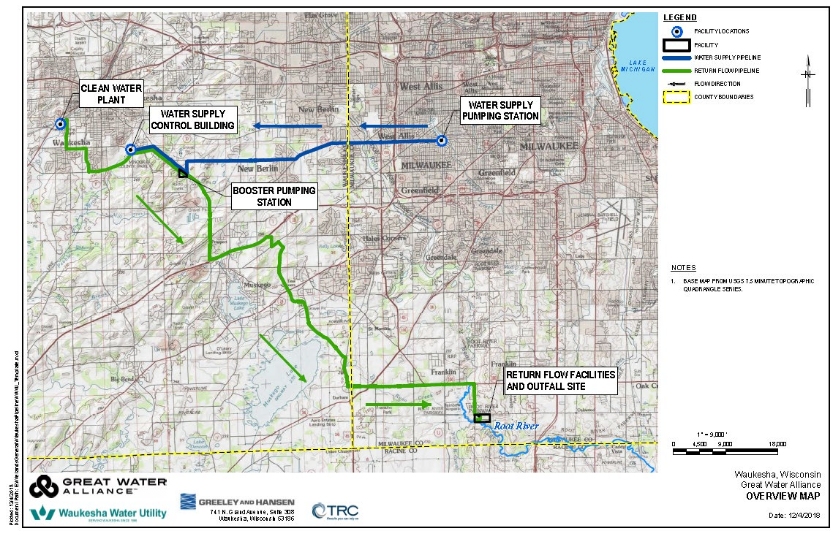
The Effluent Problem
Why did the planners of Waukesha's Great Lakes Water Diversion go way, way
out of their way to dump water from Waukesha County Wisconsin into The Root
River, Two Counties away in Racine County?
The amount of pipe used to go from the city of Waukesha to a remote spot at the Milwaukee &
Racine County border where
treated "water" or effluent, is dumped into Racine County's part of the Root River. That same length of pipe could
have gone directly to lake Michigan through Waukesha and Milwaukee Counties and and the effluent would not have to have been
put in the Root River. The Wisconsin Department of Natural Resources (WDNR) has classified the
Root River as being, "impaired" for phosphorus.
The route for the return of effluent goes in a pipeline. The pipe keeps the water from
ever having a chance to harm the ground water in Waukesha County. Once that pipe crosses
the Waukesha County border you better know there is plenty little pipe.
The water that is returned is treated using current EPA and WDNR guide lines but that is not enough to protect
people from both legal and illegal drugs. These include birth control drugs, microplastics and methamphetamine.
Why was it so important to dump the effluent from Waukesha's sewage treatment plant into an impaired river in a
primarily poor rural corner of Milwaukee and Racine County? They could have run an equal amount
of pipe to lake Michigan in Milwaukee and not harm the Root River.
Local sewerage treatment does not catch it all.
Chemicals from Birth Control Pills found in water after it went through sewage treatment
"Urgent public debate is needed over a European proposal to regulate environmental
levels of the active ingredient in birth-control pills, say Richard Owen and Susan Jobling."
Nature: May 23, 2012 Vol. 485, 441 "The Hidden costs of flexible fertility",
Abstract:
https://www.nature.com/articles/485441a#citeas
"Estrogenic Effects of Birth Control Pills in Effluents from Sewage Treatment Works"
Chemestry and Ecology
Chemestry and Ecology:
October 18 1993, Vol. 8
https://www.tandfonline.com/doi/abs/10.1080/02757549408038554
" The Conversation." The BBC "Trout enjoy water that contains methamphetamine – could this lead to them
loitering around sewage pipes?"
The BBC digs into this issue.
British Broadcasting Service: London, U.K. July 18, 2021
https://www.bbc.com/future/article/20210716-why-fish-are-becoming-addicted-to-illegal-drugs
United Nations World Drug Report of 2021
https://www.unodc.org/unodc/en/data-and-analysis/wdr2021.html
"Water firms discharged raw sewage into England's rivers 200,000 times in 2019"
The Guardian: Manchester U.K. July 1, 2020
https://www.theguardian.com/environment/2020/jul/01/water-firms-raw-sewage-england-rivers
"Methamphetamine pollution elicits addiction in wild fish"
Users of illicit drugs indirectly introduce these drugs into surface waters following excretion to sewage collection systems and discharge from wastewater treatment plants.
Journal of Experimental Biology: Czech Republic July 6, 2021
https://journals.biologists.com/jeb/article-lookup/doi/10.1242/jeb.242145
"United Nations World Drug Report:"
New York, N.Y. 2015-17;
https://www.unodc.org/wdr2017/press/WDR17_Fact_sheet.pdf
"Using zebrafish (Danio rerio) models to understand the critical role
of social interactions in mental health and well being"
https://www.sciencedirect.com/science/article/pii/S0301008221000071
"Effects of chronic, parental
pharmaceutical exposure on zebrafish (Danio rerio) offspring."
Aquatic Toxocology: June 14, 2014 Vol. 151;
https://www.sciencedirect.com/science/article/abs/pii/S0166445X14000265
"Biomonitoring of pesticides,
pharmaceuticals and illicit drugs in a freshwater invertebrate to estimate
toxic or effect pressure"
Environmental International: August 2019 Vol. 129;
https://www.sciencedirect.com/science/article/pii/S0160412019307160
"The Role of Behavioral Ecotoxicology in Environmental Protection"
https://pubs.acs.org/doi/10.1021/acs.est.0c06493
"An evaluation of behavioural endpoints: The pharmaceutical pollutant
fluoxetine decreases aggression across multiple contexts in round goby
(Neogobius melanostomus)"
Chemosphere: May 2017 Vol. 175, PP 401-410
https://www.sciencedirect.com/science/article/abs/pii/S0045653517302370?via%3Dihub
"Anti-depressants make amphipods see the light Author links open overlay panel"
Aquatic Toxocology: September 2010 Vol. 99 Issue 3,
https://www.sciencedirect.com/science/article/abs/pii/S0166445X10002122
National Library of Medicine, National Center for Biotechnology Information, National Institutes of Health:
"Dilute concentrations of a psychiatric drug alter behavior of fish from natural populations"
2013 February;
https://pubmed.ncbi.nlm.nih.gov/23413353/
"Five ways fish are more like humans than you realise"
But when scientists have conducted experiments to discover more about fish -
including their neurobiology, their social lives and mental faculties - fish seem
to have more in common with [humans] than we might like to admit.
1. Fish lose their memory as they age.
2. Fish like the same drugs as humans.
3. Fish remember their friends.
4. Fish feel pain.
5. Fish can be impatient.
- https://theconversation.com/five-ways-fish-are-more-like-humans-than-you-realise-157929
This article originally appeared on The Conversation, and is republished
under a Creative Commons licence.
https://theconversation.com/fish-hooked-on-meth-the-consequences-of-freshwater-pollution-163756
"Wastewater Treatment & Water Reclamation"
National Library of Medicine:
Abstract:
Wastewater treatment is the means by which water that has been used and/or contaminated
by humans or nature is restored to a desirable quality. Treatment may consist of chemical,
biological, or physical processes or a combination thereof. Water may be treated
to any level of quality desired; however, as its purity increases, so does the
cost of attaining that purity. The required quality of water is dictated by its
intended use, for example, aquatic life, drinking water, or irrigation. The purpose of this
chapter is to describe wastewater treatment technologies predominantly in use
today. Ultimately, the technology selected as appropriate for one application
may not be the optimal for another. Selection will be based on site-specific factors,
such as resources available, climate, land availability, economics, etc.
- https://www.ncbi.nlm.nih.gov/pmc/articles/PMC7158167/